
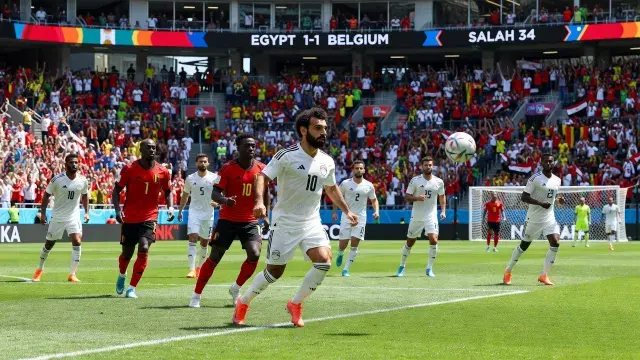
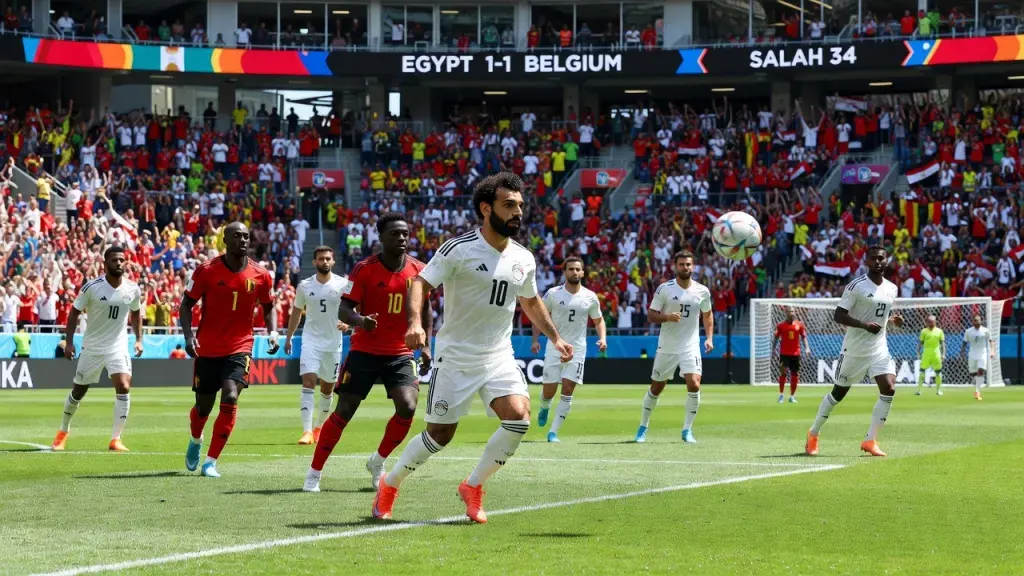
Mohamed Salah marked his 34th birthday on Monday by helping Egypt to a 1-1 draw against Belgium in Seattle, assisting the Pharaohs' opening goal of the tournament and playing a significant structural role before being withdrawn with 15 minutes remaining. It was a performance that illustrated, with some clarity, the central misunderstanding that has followed him throughout the most celebrated chapter of his career: that he operates alone, or that he should be the fixed point around which everything else is arranged. Neither version of that idea is quite right.
The notion that elite individual talent functions in isolation is one of sport's most persistent myths, cutting across disciplines as different as tennis and football, and as statistically driven as anything you might find when browsing badminton odds online. The truth with Salah has always been more layered. He has needed the right architecture around him at every stage - at Liverpool, that meant Trent Alexander-Arnold threading passes from deep and Roberto Firmino creating disorder in the spaces between the lines, with hard-runners in midfield opening the corridors that allowed him to punish defenses. With Egypt, the same logic applies: Emam Ashour must be functional, Marwan Attia needs to agitate in the channels, and Mohamed Hany has to offer width and forward momentum from right back. Remove those components and Salah, for all his quality, is diminished.
The System Question: What Seattle Revealed
Egypt coach Hossam Hassan made a tactically interesting decision in Seattle, deploying Salah not from the right flank - his customary position for club and country across the best part of a decade - but as a second striker alongside Omar Marmoush. The shape in possession bore a resemblance to the 4-4-2 that Argentina refined so effectively in Qatar in 2022, the system that finally gave Lionel Messi the structural support to win a World Cup at his fifth attempt. Whether Hassan made the connection consciously is less important than the result: Salah had more influence on proceedings than his conventional wide role would typically allow.
There was also a defensive dimension that deserves attention, even if it resists easy measurement. When Belgium moved forward, Salah dropped into a No. 10 position and sat between the two Belgian holding midfielders - Amadou Onana and Youri Tielemans - without pressing aggressively or sacrificing his attacking threat. The effect was subtle but real. Both midfielders had to account for his presence, which gave Egypt's more industrious central players extra space to operate. It is exactly the kind of contribution that disappears in raw data but shapes a game's architecture. Hassan had clearly briefed him on the role, and Salah executed it with the intelligence of someone who understands systems, not just goals.
The Messi Parallel and What It Actually Means
The comparison between Salah and Messi is imperfect in most respects, but one dimension holds. Messi spent years carrying the label of a player who could not do it at international level, who needed carrying when the pressure grew heaviest. It was largely unfair but contained enough selective truth to persist. It took a World Cup winner's medal, and crucially a functioning team built to support rather than simply feed him, to settle the argument. The Salah debate has a similar shape. Two unhealthy impressions have calcified over time: one that he carries teams entirely on his own back, the other that teams must carry him because he does not contribute defensively. Both contain fragments of truth and both distort it.
Without Salah, Liverpool do not win what they won during the Klopp era - the numbers and the moments are irreducible proof of that. Without him, Egypt do not qualify for this World Cup, their first since 1990. That is not a small thing. Yet last season at Anfield, Salah found himself isolated in a way that served neither him nor the club well. Arne Slot's decision to restructure the attack around Florian Wirtz did not deliver what was intended, and the players behind and alongside Salah were not producing the relationships the system required. He was peripheral in too many matches, not because his quality had evaporated but because the scaffolding was gone. The pace that once made him genuinely frightening has reduced with age, but the footballer who replaced that pace - positionally shrewd, still lethal inside the final third, capable of reading game state - is not a diminished version so much as a different one, and one that still requires the right conditions to function at the top level.
Egypt, Belgium, and What Comes Next
The draw itself felt like a measured outcome for a squad with realistic World Cup ambitions. Ashour's goal - a sweeping, left-footed finish from a Salah pass, precise enough to beat Thibaut Courtois - gave Egypt early control, and the structural discipline Hassan imposed kept Belgium at arm's length for long stretches. The equaliser, an own goal by Hany as he tried to cut out a Romelu Lukaku cross, was unfortunate rather than a defensive collapse. Lukaku, himself 33, had been on the pitch for only seconds when the moment arrived. Belgium's squad carries experience and Courtois remains world class, but Egypt will have felt they contained a side with real pedigree.
Hassan's post-match comments were telling. He singled out Marmoush and Salah for giving everything in sweltering conditions - it was approaching 90 degrees at kickoff in Seattle, a midday start in intense heat that made the decision to substitute Salah with 15 minutes left both logical and, in hindsight, correct. Egypt still have New Zealand and Iran to come in the group stage, and the draw preserves their options. For Salah, the tournament is just beginning. The misunderstanding about what he is and what he needs will probably persist. What Seattle offered, at least, was evidence that when the system is right and the people around him are functioning, he still matters enormously - not because everything runs through him, but because everything works better when he is part of it.
