
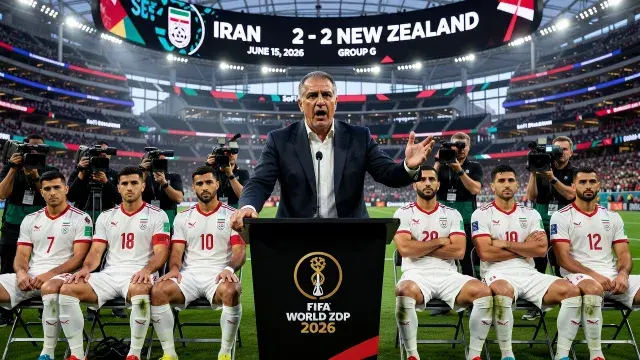
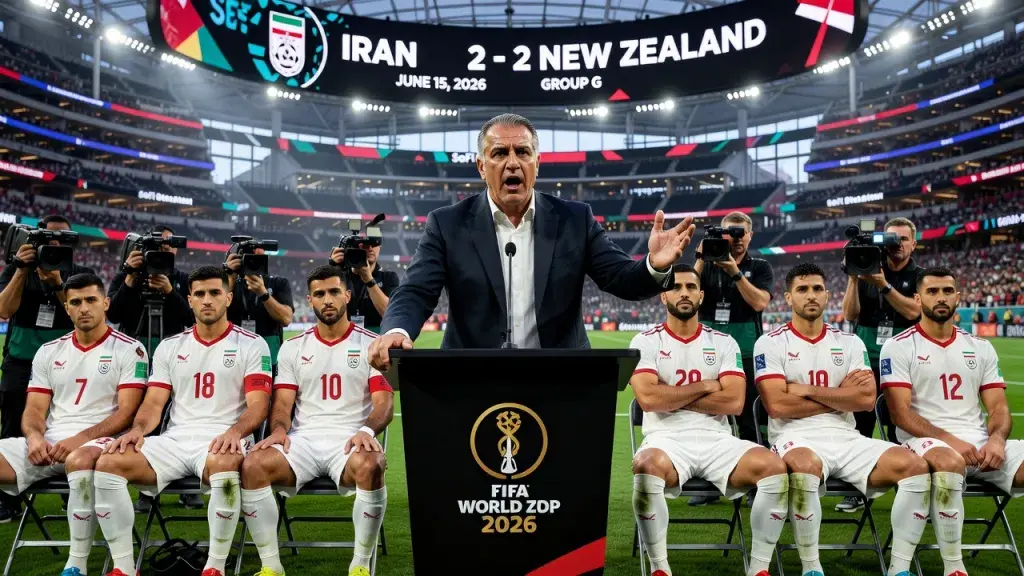
Iran drew 2-2 with New Zealand in a politically charged opening Group G match at SoFi Stadium in Inglewood on Monday, June 15, 2026 - but the conversation after the final whistle was dominated not by goals or tactics, but by visa complications, last-minute travel orders, and a coaching staff barred from entering the United States. Head coach Amir Ghalenoei used his post-match press conference to declare that his side may be "the most oppressed team in the whole World Cup," setting the tone for what promises to be one of the most politically loaded campaigns in the tournament's history.
Forced Departure and the Tijuana Commute
Iran's logistical situation has been extraordinary even by the standards of a 48-team World Cup sprawling across three nations. Their main base camp was relocated from Arizona to Tijuana, Mexico, weeks before the tournament began - despite the fact that all three of their group-stage fixtures are being played on United States soil. Under the agreed framework, teams travel into the US two days before each match. Iran arrived in Los Angeles on Sunday, June 14, but according to Ghalenoei, their post-match plans were altered at the eleventh hour once again. ESPN reported that the trigger was an expired visa belonging to striker Mehdi Torabi, which prompted US authorities to require the entire squad to return to Tijuana immediately after the final whistle. The cross-border commute - repeated multiple times across the group stage - has left the Iranian camp visibly frustrated. It is worth noting that sports with their own complex logistical ecosystems, from netball betting markets to global athletics circuits, rarely see athletes subjected to international travel disruptions of this kind during active competition windows. "We spend so much time in the air for the commute. They don't even give us time to rest," Ghalenoei said. "After the match, they told us we had to leave immediately. It was very important for us to have recovery time. However, we have been told to return to our camp in Tijuana. We are really disturbed by that." netball betting
Infantino Visits, But Questions Remain for FIFA
Iran captain Mehdi Taremi revealed that FIFA President Gianni Infantino made a personal visit to the Iranian dressing room after the match against New Zealand - an unusual gesture that speaks to the sensitivity surrounding the team's participation. Taremi's response, however, was measured and pointed in equal measure. "Of course, he wants to try to help us, but it's also about other things. Everyone knows that. I don't need to mention it because you know where we are," Taremi said. "I think FIFA should help us more than this. Let's see what happens in the future." Both Taremi and Ghalenoei expressed frustration that Mehdi Taj, the President of the Iranian Football Federation, along with several support staff members, were denied US visas entirely and could not travel to Los Angeles for the match. "It was all a disaster for us," Taremi said flatly. White House 2026 World Cup Task Force Executive Director Andrew Giuliani pushed back on the Iranian camp's grievances in an interview with ABC News, insisting the US had acted in good faith. "I think the United States has been more than fair. We have obtained visas for all 31 players, obtained visas for each coach, so that way a competitive balance can be created," Giuliani said, acknowledging that visas for some surrounding officials had been denied.
History in Los Angeles, Flags in the Stands
Iran have become the first nation to compete at a World Cup hosted by a country with which they are in an active state of geopolitical conflict - a distinction that added extraordinary weight to every moment at SoFi Stadium. Los Angeles is home to the largest Iranian diaspora population outside Iran itself, a community shaped in large part by those who left following the 1979 Islamic Revolution. The Iranian national anthem was met with a mixture of boos and passionate cheers from the 70,108 in attendance, reflecting the deep political divisions within the community. Once play began, however, unified support rang around the stadium. Ramin Rezaeian and Mohammad Mohebbi scored for Iran - Mohebbi taking time post-match to thank the Iranian community in the city directly. "I want to thank the Iranian people living in Los Angeles. They created an amazing atmosphere in the game," he said. Ghalenoei echoed the sentiment: "There are many Iranians here. They have different political affiliations, different beliefs, but they all wholeheartedly support us. I think it's a victory for all of us." In the stands, both pre-revolutionary Lion and Sun flags and post-revolutionary flags were raised in celebration. FIFA had banned the Lion and Sun symbol in an emergency ruling issued on the morning of the match itself, but the ban appeared difficult to enforce across a stadium of that size.
Group G Standings and What Comes Next
New Zealand equalised to ensure the points were shared, leaving all four sides in Group G - Iran, New Zealand, Belgium, and Egypt - level on one point each after the opening round of fixtures. Iran's schedule does not get easier. Their next assignment is against Belgium in Inglewood, one of Europe's most technically accomplished squads, before they close out the group stage against Egypt in Seattle. Whether the team's off-field circumstances improve between now and that Belgium fixture remains the central question hanging over their campaign. The football itself showed Iran are capable of competing at this level - but competing at a World Cup while shuttling between countries, managing expired visas, and preparing without key federation officials is a test no squad should reasonably be asked to pass.
