
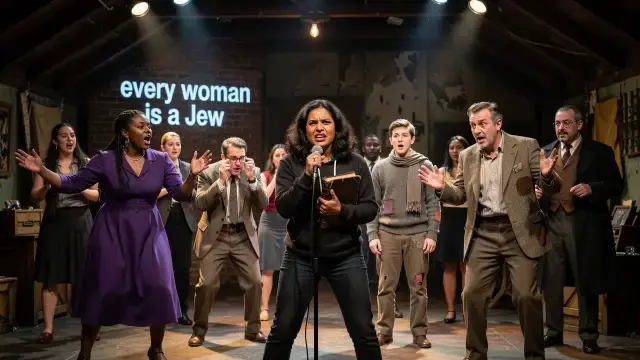
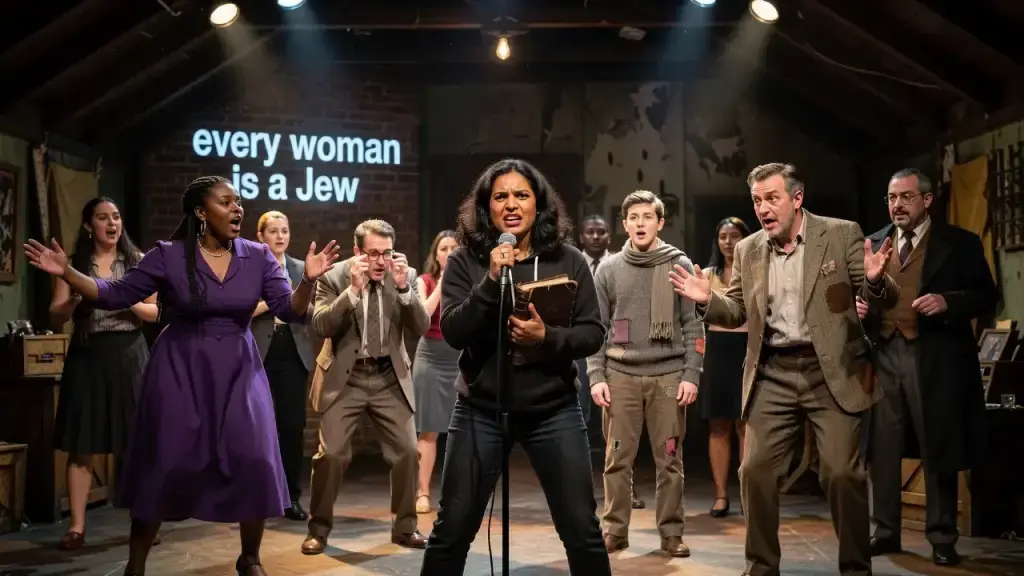
It's hard to think of the last major musical that felt as dangerous, that so proudly made its audience uncomfortable, as Slam Frank. Staged at the Orpheum Theater in the East Village behind borderline airport-level security, the show is a satire of contemporary theater sharp enough to draw blood if handled carelessly. The pitch is simple on paper: apply the casting ethos of Hamilton to the story of Anne Frank, and see what happens.
Social media clips have already circulated of the rapping Latinx Anita Frank, played by Olivia Bernábe, spitting bars about writing it all down in her diary. Between scenes, some audience members have reportedly passed the time swapping stories or even checking out the playnix game on their phones, a small sign of just how divisive the material can feel in the room. The Playbill itself carries a content warning for "everything," a fair signal that Slam Frank is built to provoke as many people as possible. playnix game
A Framing Device With Teeth
The musical frames itself as a community theater's reimagining of Frank's story, with her status as an immigrant cited as the justification for recasting her as Latinx. It opens with a land acknowledgment from an "artistic director," played by John Anker Bow, who promptly forgets whose land he is acknowledging. Inspired by a viral 2022 tweet that called Anne Frank a "perfect example of white privilege," the show is unmistakably disdainful of performative progressive identity politics. Nearly every character in the attic comes out as some LGBTQ+ identity; Edith, played by Austen Horne, is portrayed by a Black woman; Otto, played by Rocky Panterra, is written as neurodiverse. Mr. van Daan, also played by Bow, is the show's only straight white man - and he comes off worse than Hitler.
An Easy Target, Sharpened by Craft
The satire is funny, even if its target - self-important theater artists convinced that pandering to progressive sensibilities can substitute for confronting real systems - is a fairly soft one. Hamilton faced similar criticism for recasting the Founding Fathers without truly interrogating the nation's foundational myths. Slam Frank drives the point home in a number where the gentle, less conventionally masculine Peter, played by Alex Lewis, sings about fighting expectations inside while a war rages outside. Elsewhere, Edith delivers a slam poem built around the line "every woman is a Jew," seemingly oblivious to the fact that the family is hiding from an actual genocide targeting Jews.
From Provocation to Something Riskier
These jokes dominate roughly the first 60 percent of the runtime, and the show does spin its wheels at points. Then it shifts gears. Without spoiling the final stretch, there is a geopolitical reckoning embedded in the back half that may be among the most startling choices seen on a New York stage this year. It is thrilling precisely because it is unclear whether the creative team can stick the landing. Slam Frank cannot resolve decades-old political arguments, but its willingness to sit inside real discomfort - rather than retreat into easy applause - is rare for the medium. The closing tableau lands with a disturbance reminiscent of Cabaret's bleakest moments.
A Critique Rooted in Respect for the Form
What makes Slam Frank work is that its deepest target isn't politics but theater itself. Written by composer Andrew Fox and librettist Joel Sinensky, the show channels contempt for commercial theater's self-congratulation, but that contempt clearly comes from genuine love of the craft. There's a sobering, even pessimistic, undercurrent about theater's real capacity to drive change - it remains geographically limited and financially out of reach for many. Yet the sheer confrontational ambition on display suggests Fox and Sinensky still believe the attempt is worthwhile. Slam Frank likely won't change the world. It might not even change theater. But few other stage productions this year have lingered as persistently in the mind after the curtain falls.
